
IVF Treatment: Process, Benefits, Risks and What to Expect
Trying for a pregnancy can become stressful when months pass without a clear answer. In such situations, the first step should not be rushing into treatment. The better approach is to understand why pregnancy is not happening and then choose treatment according to the actual cause.
Issues can stem from the female partner, male partner, both or sometimes even with no clear reason at all. According to the World Health Organisation, infertility is defined as a disease characterised by the failure to attain a clinical pregnancy after 12 months or more of regular unprotected sexual intercourse. Control Group. In fertility care, IVF is one of the treatment options available.
At our centre, we believe IVF should never feel like a confusing list of injections and laboratory procedures. Patients should understand what is being done, why it is being suggested and what they can realistically expect.
What Is IVF Treatment?
IVF – In Vitro fertilisation. In short, eggs are harvested from the ovaries and fertilised with sperm within a laboratory. The resulting embryo is then implanted into a uterus.
Not every fertility problem requires IVF as the initial treatment. That means some may require medications, monitoring and lifestyle changes to improve outcomes; treatment of an underlying condition, surgery or intrauterine insemination (IUI) before IVF will be suggested.
This is why a thorough fertility evaluation is more important than picking a treatment by name alone.
Who May Consider IVF?
A fertility specialist may discuss IVF when pregnancy has not happened naturally and other factors make assisted reproduction suitable. IVF may be considered in situations such as:
- Blocked or damaged fallopian tubes
- Problems with sperm count, movement or quality
- Endometriosis affecting fertility
- Ovulation-related problems, including some cases of PCOS
- Unexplained infertility
- Certain genetic conditions
- Fertility concerns related to age
- Previous fertility treatments that have not resulted in pregnancy
Our view
One mistake we often see is that the entire fertility discussion starts with the woman. A useful assessment should look at both partners from the beginning. It can save time, reduce unnecessary tests and give the doctor a clearer picture.
How Does the IVF Process Work?
The exact treatment plan differs from one person to another, but an IVF cycle commonly includes the following stages.
-
Fertility AssessmentBefore starting IVF, the doctor studies your medical and fertility history.
Depending on the situation, assessment may include:- Ultrasound examination
- Hormone tests
- Ovarian reserve assessment
- Semen analysis
- Evaluation of the uterus and fallopian tubes
- Previous pregnancy or treatment history
-
Ovarian StimulationNormally, the ovaries may release one mature egg during a menstrual cycle. During IVF, fertility medicines are generally used to encourage the development of several follicles.
The response is monitored through ultrasound scans and, when required, blood tests.
There is no single injection schedule suitable for every patient. Medication type, dosage and duration depend on factors such as age, ovarian reserve and response to stimulation. -
Egg RetrievalWhen the follicles reach the required stage, the doctor schedules egg collection.
Egg retrieval is generally carried out using a fine needle guided through ultrasound, with appropriate sedation or anaesthesia.
Patients are usually given instructions about eating, medicines, arrival time and care after the procedure. -
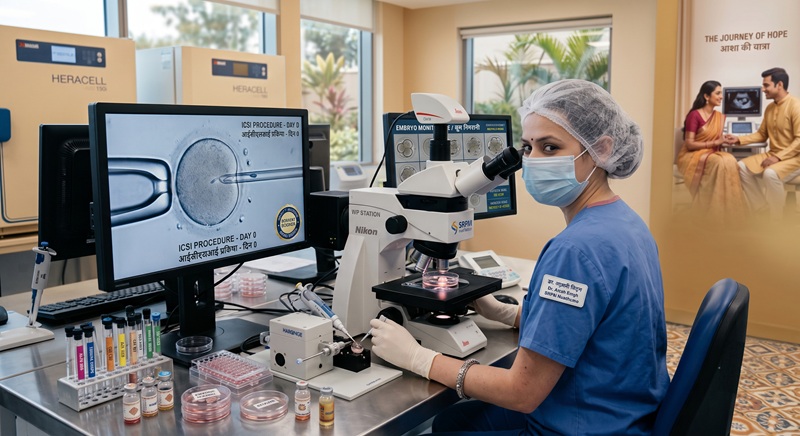
Sperm Collection and FertilisationA semen sample is prepared in the laboratory and suitable sperm are selected.
Eggs may then be fertilised through conventional IVF or, in selected cases, ICSI (Intracytoplasmic Sperm Injection), where a single sperm is introduced into an egg. The method is selected according to the couple’s fertility situation rather than being automatically required for everyone. -
Embryo DevelopmentAfter fertilisation, embryos are observed in controlled laboratory conditions for the next few days.
Embryologists look at how they develop before the fertility team decides which embryo may be suitable for transfer or freezing.
Some patients may also be advised to discuss genetic testing of embryos when there is an appropriate medical reason. -
Embryo TransferDuring embryo transfer, an embryo is carefully placed inside the uterus using a thin catheter. Anaesthesia is usually not required for a routine embryo transfer.
Not every patient should have multiple embryos transferred. The number depends on medical history, age, embryo characteristics and the doctor’s assessment. -
Pregnancy Test and Follow-UpAfter embryo transfer comes what many patients find to be the hardest part emotionally: waiting.
A pregnancy test is generally planned later according to the fertility specialist’s instructions. The result cannot be reliably judged from symptoms alone.
Some people experience mild cramping, heaviness or no symptoms at all.
Symptoms are not a pregnancy test.
That is one of the most useful things to remember during this stage.
What Can Affect IVF Outcomes?
Important factors can include:
-
Age
Age, particularly the age of the person providing the eggs, can influence fertility and IVF outcomes. The Apollo Fertility reference page also lists age among the important factors affecting IVF results. -
Egg and Sperm Factors
The number and characteristics of available eggs and sperm can influence fertilisation and embryo development. -
Ovarian Reserve
Ovarian reserve helps doctors understand how the ovaries may respond to stimulation. It does not, by itself, predict everything about a person’s chance of pregnancy. -
Medical Conditions
Conditions involving the uterus, ovaries or reproductive system may influence the treatment approach. WHO identifies tubal disorders, endometriosis, PCOS and other ovarian or endocrine problems among causes associated with female infertility. -
Embryo Development
Not every fertilised egg develops in the same way. Embryo development is therefore an important part of the IVF process. -
Previous Treatment History
Past pregnancies, miscarriages, IVF cycles or other fertility treatments can help doctors plan the next step.
How Should You Prepare for IVF?
There is no special food or home remedy that can guarantee IVF success.
The practical approach is much simpler:
- Follow medicines exactly as advised
- Attend scans and blood tests on schedule
- Tell your doctor about existing medicines or health conditions
- Avoid smoking
- Discuss alcohol use with your doctor
- Follow a balanced everyday diet
- Get reasonable sleep
- Ask questions whenever instructions are unclear
WHO notes that smoking, excessive alcohol intake and obesity can affect fertility, although fertility problems can have many different causes.
Do not start supplements, herbal products or fertility medicines simply because they worked for somebody online. Discuss them with your treating doctor first.
Choosing an IVF Centre: What We Believe Matters
People often begin by comparing success rates.
We think that is incomplete.
Before starting IVF, ask:
- Who will explain my diagnosis?
- Why is IVF being advised in my case?
- Who will monitor my cycle?
- What laboratory support is available?
- What happens if my ovaries respond differently than expected?
- What are the possible risks in my case?
- What happens if the first cycle does not result in pregnancy?
- Will I receive clear information before each major decision?
In India, assisted reproductive technology services operate within the framework of the Assisted Reproductive Technology (Regulation) Act, 2021, so patients should also look for appropriate registration and regulatory compliance when assessing a fertility centre. (Indian Council of Medical Research)
A fertility clinic should not make you feel hurried into treatment. Good care begins with clear information.
IVF Treatment Is a Process, Not a Promise
For many couples, IVF may become an important part of their fertility journey. But the decision should come after understanding the cause of infertility, available alternatives, possible risks and realistic expectations.
Our approach is simple: do not treat every fertility problem with the same plan.
Listen first. Investigate carefully. Explain the findings. Then decide the next step together.
That approach may sound less dramatic than promises and percentages, but it is far more useful for patients making a deeply personal medical decision.

The active stages of ovarian stimulation, egg collection, fertilisation and embryo transfer commonly take several weeks, but the complete timeline varies. Some patients may require treatment or preparation before stimulation, while frozen embryo transfer may happen in a later cycle.
IVF involves injections, ultrasound monitoring and egg retrieval, so some discomfort is possible. Egg retrieval is generally performed with appropriate sedation or anaesthesia. Experiences differ, so discuss pain control and recovery with your fertility team.
There is no fixed number. Some people achieve pregnancy after one cycle, while others may require additional treatment. Age, diagnosis, egg and sperm factors, embryo development and previous treatment history can all influence the outcome.
Routine prolonged bed rest is generally not something patients should assume is necessary. Follow the specific instructions given by your fertility specialist, especially regarding exercise, medicines and daily activities.
WHO defines infertility as failure to achieve pregnancy after 12 months or more of regular unprotected intercourse. However, earlier medical advice may be appropriate when there are known reproductive health problems or age-related concerns. (World Health Organization)
Medical note: This page is for general information and cannot replace an individual fertility assessment. IVF plans, medicines and procedures should be decided with a qualified fertility specialist based on personal medical history.